
 Send Inquiry
 0804580023608045800236


 English
 Spanish
 French
 German
 Italian
 Chinese (Simplified)
 Japanese
 Korean
 Arabic
 Portuguese

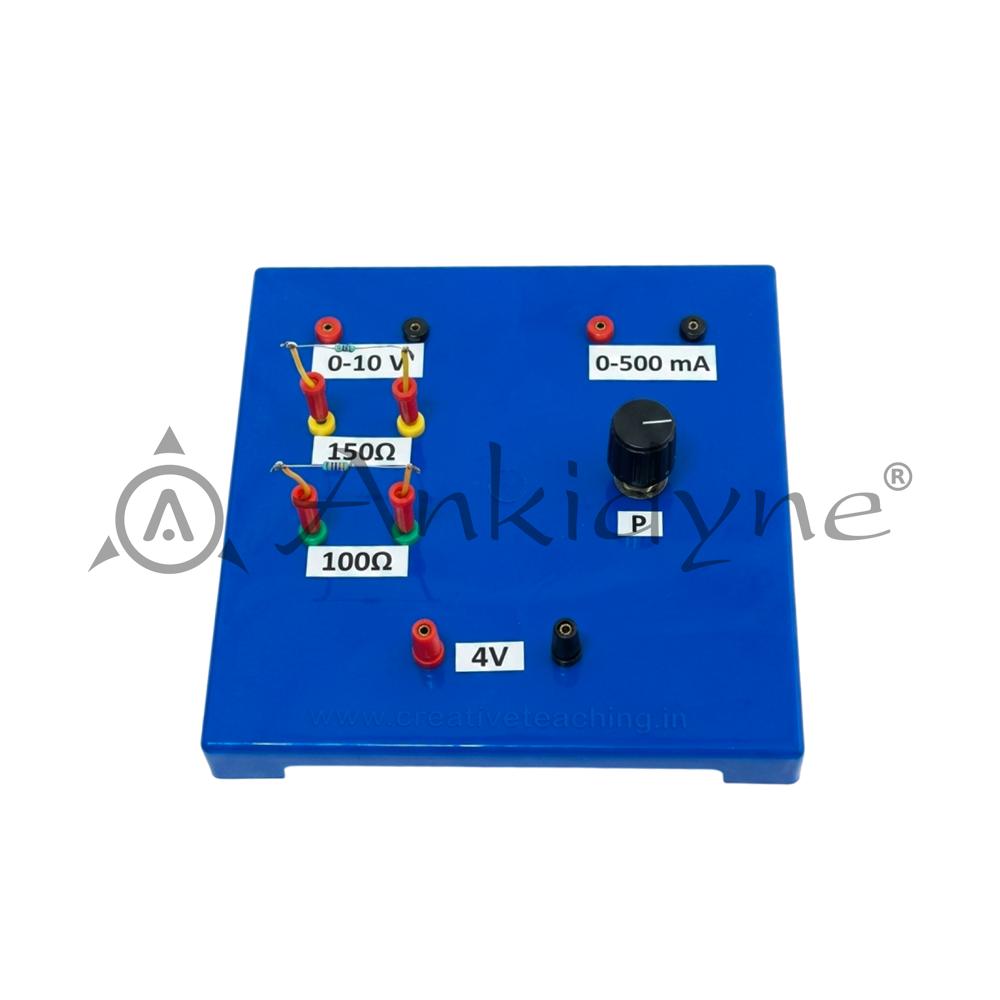
Resistance In Parallel
1674.0 INR/Piece
Product Details:
- Age Group For educational and laboratory use (schools, colleges)
- Power DC Supply, typically 4V input
- Product Type Resistance In Parallel Demonstration Box
- Material Molded plastic body, metal resistance terminals, electronic components
- Color Blue
- Style Educational Lab Equipment
- Dimensions Approx. 20 cm x 16 cm x 7 cm
- Click to view more
X
Resistance In Parallel Price And Quantity
- 2 Piece
- 1674.0 INR/Piece
Resistance In Parallel Product Specifications
- Educational Lab Equipment
- Blue
- Resistance In Parallel Demonstration Box
- To demonstrate and study resistances connected in parallel using known resistors
- Molded plastic body, metal resistance terminals, electronic components
- Approx. 20 cm x 16 cm x 7 cm
- For educational and laboratory use (schools, colleges)
- DC Supply, typically 4V input
- Banana socket terminals for easy connections
- Physics Lab Practical, Electrical/Electronics Lab Experiments
- Insulated body and terminals to prevent accidental shocks
- Desk/Bench-top portable design
- Analog voltage and current indication (as per meter connected externally)
- 150 and 100 Fixed Resistors
- Voltage: 0-10V, Current: 0-500mA
- Variable parallel resistor adjustment
Product Description
Enhances conceptual understanding. It promotes a solid understanding of parallel resistances, voltage division, current distribution, and power calculations. Students can grasp these fundamental concepts more effectively through interactive experimentation.Versatile Educational Laboratory Tool
Designed specifically for physics and electronics experiments, this resistance box allows students and educators to easily explore the behavior of resistors in parallel. Its insulated construction protects users, making it suitable for repeated handling in classroom settings. The convenient banana sockets simplify circuit setup and alteration, ensuring that practical demonstrations are efficient and accessible to learners of various ages.
Precise Measurements for Effective Learning
With a measurement range accommodating up to 10V and 500mA, this equipment supports detailed analysis of voltage and current in parallel circuits. Analog meters (connected externally) provide instant, readable feedback, reinforcing key concepts while facilitating hands-on understanding of electrical parameters. The device's design ensures consistent results, suitable for graded lab work or demonstration purposes.
FAQ's of Resistance In Parallel:
Q: How do I connect external meters to the Resistance In Parallel apparatus?
A: External analog voltage and current meters can be conveniently attached using the provided banana socket terminals. Simply insert the meter leads into the corresponding sockets for voltage and current, then adjust the circuit as needed for your experiment.Q: What is the primary benefit of using fixed 150 and 100 resistors in this device?
A: The included 150 and 100 fixed resistors provide a reliable standard for demonstrating parallel resistance concepts. This consistency enables accurate measurement, comparison, and calculation of theoretical versus experimental values in educational settings.Q: When should I use the variable parallel resistor adjustment knob?
A: Use the variable parallel resistor knob when you want to introduce additional resistance in parallel to the fixed resistors. Adjusting the knob allows you to observe changes in total circuit resistance, voltage, and current, deepening your understanding of parallel networks.Q: Where is this resistance apparatus most commonly utilized?
A: This product is primarily used in school and college laboratories, specifically in physics and electrical engineering practical sessions. Its educational design makes it suitable for hands-on experiments, demonstrations, and assessments.Q: What safety features are included to protect users during operation?
A: The device features insulated body and terminals, significantly reducing the risk of accidental electric shocks during experiments. This makes it safe for students and teachers handling live electrical circuits in a lab setting.Q: How does the analog display function in this setup?
A: The device relies on externally connected analog meters for voltage and current indication. These meters reflect real-time readings based on the wiring configuration, helping users correlate theoretical calculations with measured values.Tell us about your requirement

Price:
Quantity
Select Unit
- 50
- 100
- 200
- 250
- 500
- 1000+
Additional detail
Mobile number
Email

Other Products in 'Teaching Aids' category

Contact Details

- No. 46, 1st Main Road, New Colony, Chromepet,Chennai - 600044, Tamil Nadu, India
- Phone : 08045800236
ANKIDYNE PLAYGROUND EQUIPMENTS & SCIENCE PARK
An ISO 9001 : 2015 Certified
An ISO 9001 : 2015 Certified

- Mr Padmanabhan A S (Marketing Director)
- Mobile : 08045800236
- info@ankidyne.com
- Fax : +91 44 66904488

|


 Send Inquiry
 Send SMS
 Call Me Free
ANKIDYNE SCIENCE PARK & PLAYGROUND EQUIPMENTS
All Rights Reserved.(Terms of Use)
Developed and Managed by Infocom Network Private Limited.
Developed and Managed by Infocom Network Private Limited.

