Product Description
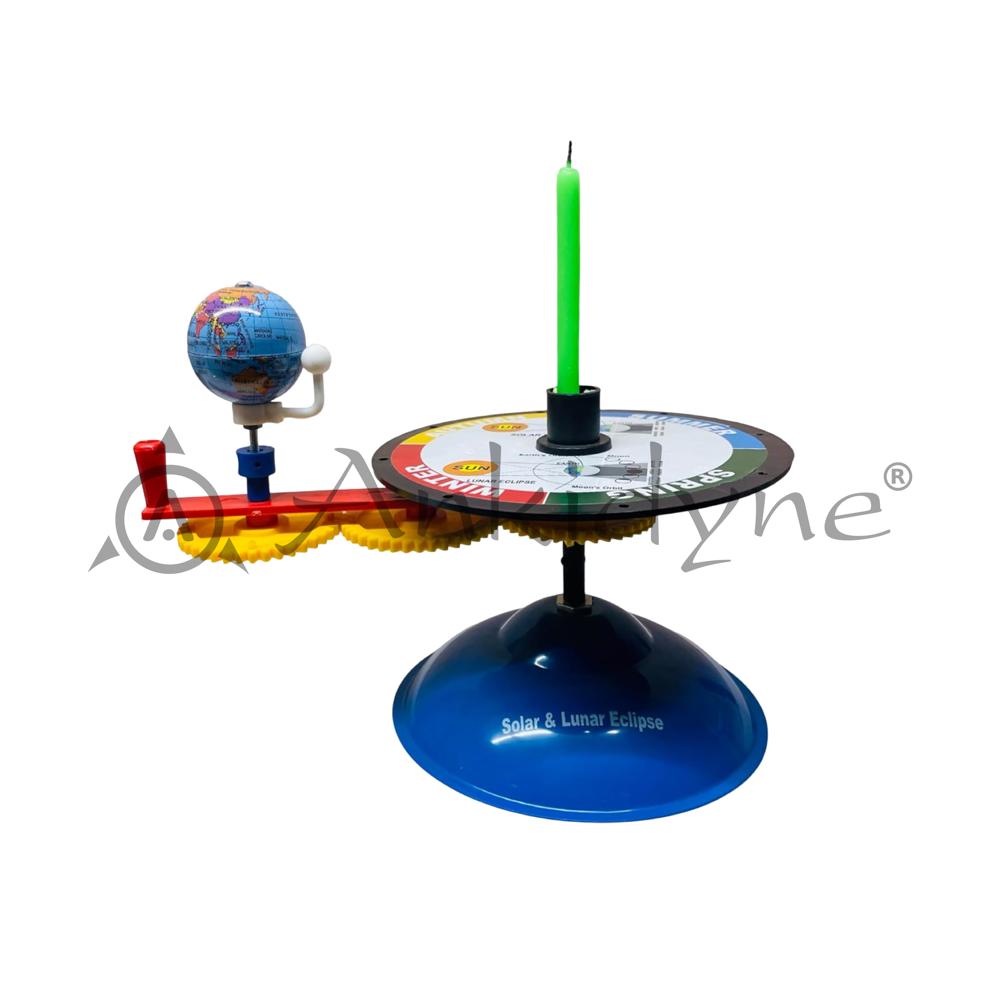
The Solar & Lunar Eclipse Model is a dynamic, multi-functional astronomy teaching aid designed to demonstrate the occurrence and mechanism of both Solar Eclipse and Lunar Eclipse in an interactive and visually engaging manner. This model also simultaneously illustrates the Four Seasons of the Earth, making it a comprehensive tool for geography and earth science education.
The model features a rotating gear-driven mechanism mounted on a sturdy blue dome-shaped base labelled "Solar & Lunar Eclipse." A detailed miniature globe is mounted on a red and blue arm extending from the central gear assembly, with a small white ball (Moon) attached alongside to represent the Earth-Moon system. A green candle/torch holder at the centre of a circular seasonal diagram disc represents the Sun, around which the Earth-Moon assembly rotates to simulate orbital movement.
Engaging Visual DemonstrationsThis model offers a richly interactive experience for students and teachers, making abstract concepts like eclipses accessible. The color-coded, labeled sections for solstices, equinoxes, and seasons help contextualize orbital mechanics, promoting understanding of Earth-Sun-Moon relationships. Its clear design and robust construction ensure long-lasting, high-impact classroom demonstrations.
Simple, Safe, and Portable DesignAssembly of the model is straightforward, requiring no special tools-each component fits together with ease. Its lightweight build (about 400-600 grams) allows for convenient transport between classrooms or venues. The secure candle holder permits safe demonstrations; however, adult supervision is advised when using an open flame.
Ideal for Diverse Educational ApplicationsFrom science classrooms and fairs to interactive STEM workshops, this model supports a wide range of educational environments. Its clarity, durability, and versatility make it suitable for teachers, students, demonstrators, and curriculum designers alike. The manually operated rotating handle provides a memorable, hands-on method for exploring eclipse phenomena.
FAQ's of Solar And Lunar Eclipse Model:
Q: How does the Solar and Lunar Eclipse Model help students understand eclipse phenomena?
A: By allowing students to physically manipulate the model, they visualize the relative positions and movements of the Earth, Sun, and Moon that result in solar and lunar eclipses. The rotating handle and labeled disks make complex astronomical events clear and tangible.
Q: What components are included in the kit, and what do they represent?
A: The set includes a model Earth, a candle (Sun representation), a rotating gear mechanism, color-coded base, a labeled disk illustrating months and seasons, and a secure candle holder. Each part is designed to simulate actual celestial bodies and their movement patterns.
Q: When is this model typically used in an educational setting?
A: It is ideal for science curriculum lessons, classroom demonstrations, STEM education workshops, and science fairs, particularly when teaching about eclipses, seasons, or astronomical movements to students in grades 4 and above.
Q: Where can this model be effectively utilized?
A: The model is suited for use in school science classrooms, educational institutions, interactive workshops, and demonstration booths at science fairs. Its easy assembly and portability also allow it to be shared between locations.
Q: What is the assembly process like for this model?
A: Assembly is straightforward: components easily fit together without special tools. The base, gear, Earth model, and labeled disks connect securely, while the candle holder is designed to be safe and stable for classroom use.
Q: How should the model be operated during a demonstration?
A: Rotate the handle manually to simulate the movement of Earth and the Moon around the Sun. Observing the interaction of shadows and alignments allows users to visualize both solar and lunar eclipses in real time. Always use adult supervision if demonstrating with the candle flame.
Q: What are the benefits of using this eclipse model for educational purposes?
A: The model fosters interactive, visual learning, making challenging space science concepts accessible and memorable. Its robust construction ensures repeated classroom use, and its clear labeling aids in teaching about solstices, equinoxes, and seasonal changes.