Product Description
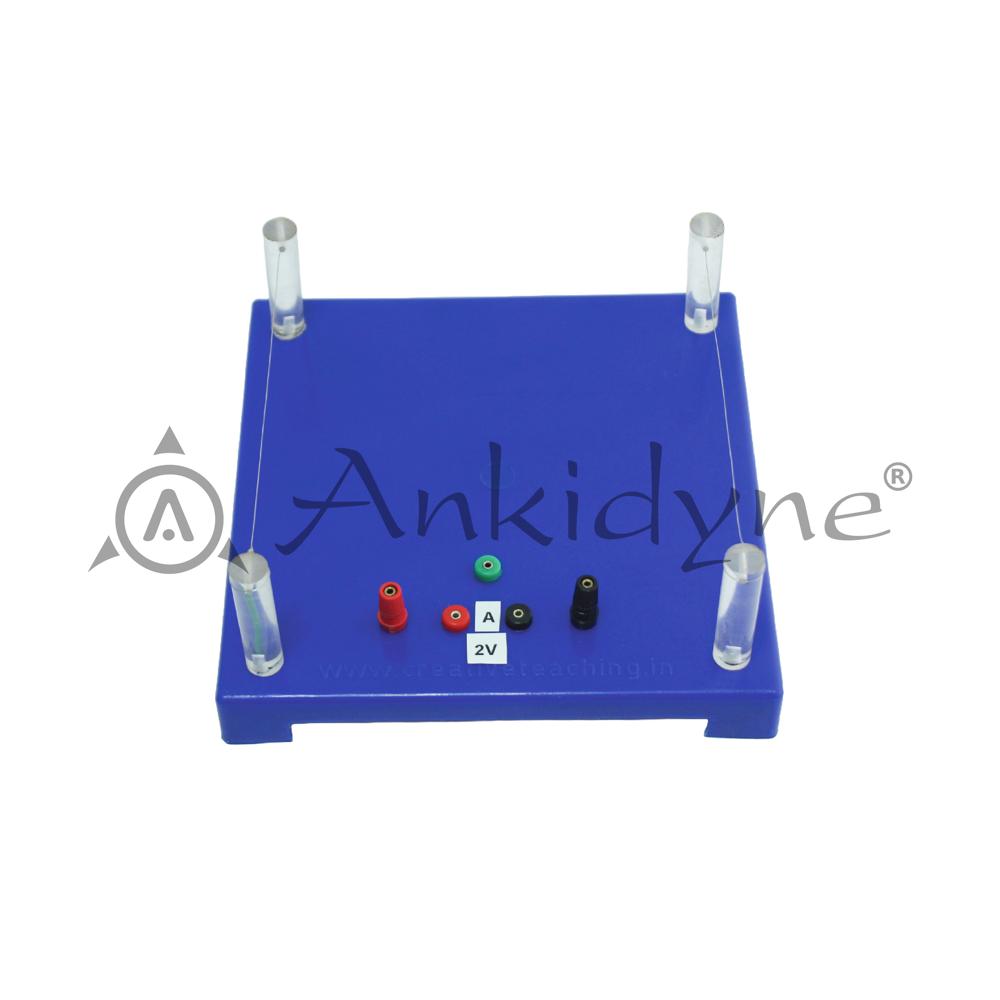
The Power Loss Due to Transmission Model is a compact and interactive physics teaching aid designed to demonstrate the concept of electrical power loss that occurs during long-distance transmission through wires. Mounted on a sturdy blue acrylic base, the model features four transparent cylindrical pillars at each corner connected by thin resistance wires simulating transmission lines, along with clearly labelled colour-coded banana plug terminals (red, green, and black) for easy circuit connections.
The model includes labelled connection points marked "A" (Ammeter) and "2V" (Voltage), enabling students to measure current and voltage drop across the simulated transmission line and calculate power loss practically.
Clear Demonstration of Transmission Power LossThis educational device allows students to visibly examine and quantify how electrical energy diminishes over a distance due to resistance in transmission wires. The included conducting wire and clear terminal setup provide hands-on experience, making the abstract concept of power loss tangible and understandable for learners in physics classes.
Robust and Easy-to-Use ConstructionEngineered from transparent acrylic supporting posts and a robust plastic or metal base, the model is both lightweight and durable. The desktop or bench-top design, colored terminal posts, and stackable 4mm sockets ensure accessible, intuitive use. Its low-maintenance nature and straightforward assembly mean educators can focus on teaching rather than setup.
FAQ's of Power loss due to Transmission:
Q: How does this apparatus demonstrate power loss during electrical transmission?
A: The model uses a thin metallic conducting wire and terminal connectors to visually and quantitatively show how electrical power decreases over a distance due to resistance. By applying a low voltage across the wire, students can observe and measure voltage and current at different points, illustrating real-world energy loss during transmission.
Q: What included accessories help with setup and operation?
A: The apparatus comes with a conducting wire, four acrylic supporting posts, terminal connectors, base, and stackable 4mm socket terminals. These accessories enable secure mounting, stable connection of wires, and straightforward integration with external circuits or power supplies, making setup easy for classroom demonstrations.
Q: When is this model typically used in an educational setting?
A: It is primarily used during physics lessons on electricity and circuits, specifically when teaching about resistance, current, voltage, and power loss in transmission lines. Its design is ideal for demonstrations, practical sessions, and hands-on experiments for high school and college-level students.
Q: Where can the apparatus be safely used and mounted?
A: The apparatus is designed for safe, desktop or bench-top use in classrooms or laboratories. Its compact footprint (about 20 cm x 20 cm x 10 cm) and lightweight build allow for easy placement and relocation within any educational environment.
Q: What is the process for connecting this model to an external circuit or power source?
A: Using the colored 4mm stackable socket terminals, students or instructors can easily connect the device to external low-voltage power supplies or measurement instruments. The straightforward terminal arrangement ensures safe and secure connections for accurate experimental results.
Q: How does using this device benefit students?
A: By providing direct, hands-on experience with electrical transmission concepts, the model bridges the gap between theory and real application. Students gain a clearer understanding of resistance, power loss, and energy transfer through visual observation and measurement, which enhances both engagement and retention of knowledge.