Product Description
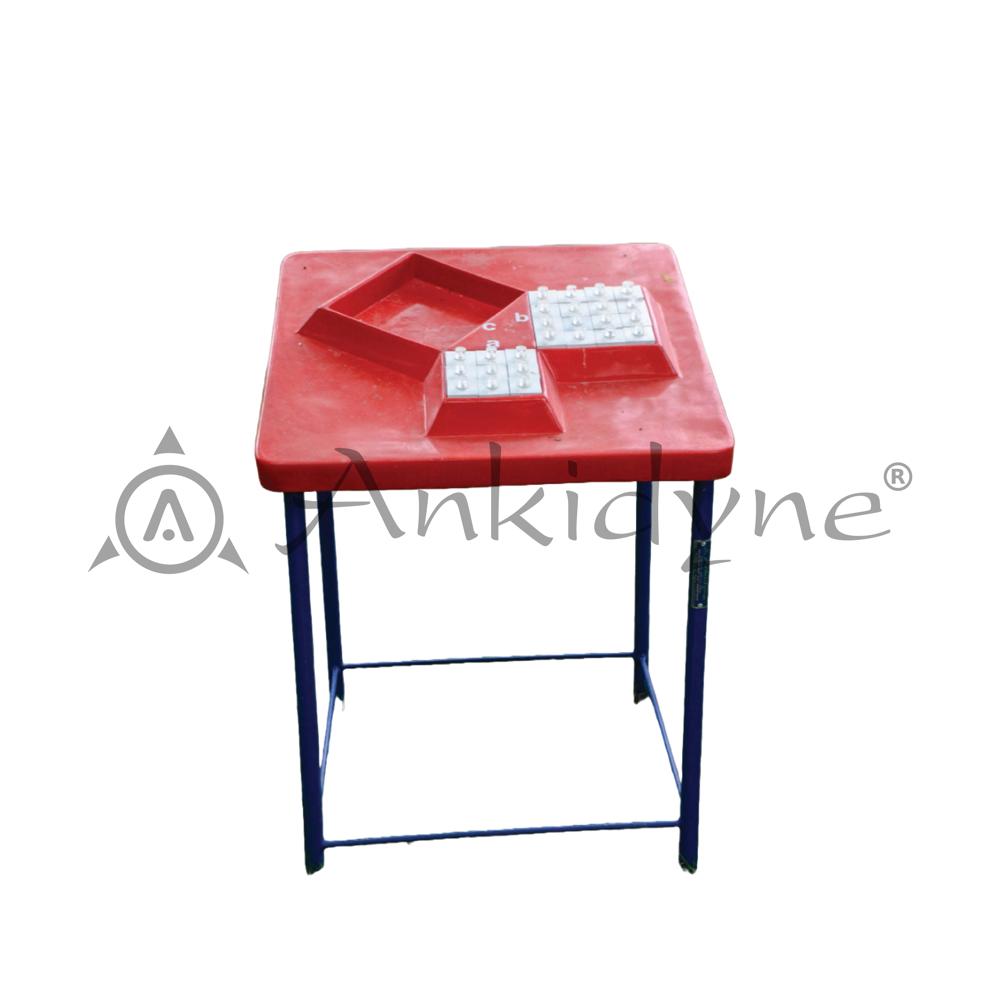
This is a Pythagoras Theorem Activity Demonstration Table, a specialized educational science and mathematics furniture piece designed for schools, science laboratories, and activity-based learning centers. The table features a permanently mounted 3D Pythagoras theorem model on a bright red FRP tabletop, supported by a robust navy blue metal frame. This product brilliantly combines furniture and a mathematical teaching aid into one integrated unit, making it an invaluable tool for teaching one of the most fundamental concepts in geometry and mathematics the Pythagorean Theorem (a + b = c).
Engaging Visual LearningThis model provides a dynamic, tangible way for students to grasp the relationship between the sides of a right-angled triangle. By physically demonstrating the equation a^2 + b^2 = c^2 using colored square sections, students can observe and understand abstract mathematical concepts through interactive visualization.
Durable and Safe ConstructionMade from premium smooth plastic over a robust metal frame, the model is both kid-friendly and resilient. Non-toxic materials and rounded, child-safe edges ensure student safety, while the non-porous surfaces resist stains and scratches, making maintenance simple and extending the model's lifespan.
Ready Out of the BoxThe apparatus is completely assembled and requires no electrical power. Its lightweight nature and compact dimensions (approximately 45 cm x 45 cm x 75 cm) make it portable, enabling effortless movement between classrooms or storage areas, maximizing usability and convenience for teachers.
FAQ's of Pythagoras Theorem Model:
Q: How does the Pythagoras Theorem Model operate in a classroom setting?
A: The apparatus visually demonstrates the Pythagorean Theorem by using three square sections that represent the squares built on the sides of a right triangle. Teachers or students can utilize it in real time to prove that the sum of the areas of the smaller squares equals the area of the largest square, facilitating a deeper comprehension of the mathematical principle.
Q: What are the primary benefits of using this model for students?
A: By providing a tangible and interactive demonstration, the model helps students of varying ages and learning styles more easily understand and retain the Pythagorean Theorem. This hands-on approach can improve engagement, foster curiosity, and support conceptual clarity in mathematics education.
Q: When is it appropriate to introduce this model during mathematics lessons?
A: The model is best utilized when introducing or reinforcing the concept of the Pythagorean Theorem, typically in classes covering geometry or foundational algebra. It is particularly effective for students aged 10 and above, aligning with upper primary through high school curriculum.
Q: Where should the model be placed for effective demonstration?
A: Ideally, position the model on a flat and stable tabletop surface at the front of the classroom where all students can easily view the demonstration. Its compact and portable design allows for flexible placement and easy repositioning as needed.
Q: What is the process for cleaning and maintaining the model?
A: Maintenance is straightforward-wipe the smooth plastic surfaces with a damp cloth to keep it clean. The materials are resistant to stains and scratches, ensuring long-term use with minimal effort.
Q: Is the apparatus suitable and safe for younger students?
A: Yes, the model is constructed from non-toxic materials and features child-safe edges, making it appropriate for students aged 10 and above. It was designed to ensure safety during classroom activities.